Pages

Showing posts with label 2010 Census. Show all posts

Thursday, March 17, 2011

Atlanta 2010 Census Population Seems to Have Been Undercounted


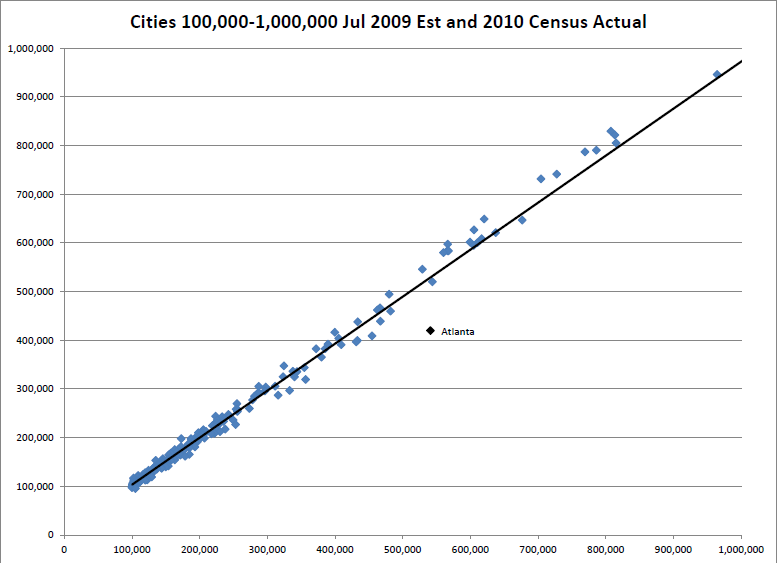
Above, is a scatterplot I made comparing the July 2009 Census Bureau estimated populations of cities with at least 100,000 people (according to the Jul 2009 estimates).

You can look at the spreadsheet I used/created for this here


Missing are the cities with over 1,000,000 people (because they make the rest of the scatterplot too small) as well as those cities with between 100,000 and 1,000,000 people from states the Census Bureau still has to release ( Maine, Massachusetts,Michigan,New Hampshire, New York, Rhode Island, South Carolina and West Virginia).

Notice how the data fits very well(even though the populations in July 2009 were slightly different from those in April 2010), with one glaring exception-the city of Atlanta, where, as it so happens, I now reside.

The July 2009 Estimate put Atlanta's population at 540,922. Today's Census 2010 release of Georgia put the April 1, 2010 population of Atlanta at 420,003, just barely up from the April 1, 2000 Census population of 416,474.

Putting aside that it just seems like there MUST have more than a 3,500 person gain based on residential development in Atlanta in the last 10 years, the chances of a city (in this case Atlanta) being more than 6 standard deviations away from the mean (no other city was more than 2.67 standard deviations away from the mean) is 1 in 500 million (assuming the error here is normally distributed, which it looks to be).

That is to say, it seems MUCH more likely that there's either a typo or a serious undercount of Atlanta's population (I tend to think they undercounted in a lot of places and not just Atlanta personally ...)

This is a very serious issue; the difference in population here is enough to account for about 1/6th of a seat in Congress, 2/3 of a seat in the Georgia Senate, and 2.25 seats in the Georgia House of Representatives, not to mention millions in population-based federal block grants.

I would strongly urge Mayor Kasim Reed to sue the Census Bureau over an undercount of Atlanta.


Anyway, all of that being said, there is the possibility that they somehow majorly majorly overlooked the "black flight" phenomenon, as the official 2010 Census numbers show a 17% increase in the white population of Atlanta but a 12% decrease in the black population (a whopping 65% increase in the Asian population, which is probably due largely to expansion of Georgia Tech). More on black flight later.

Sunday, August 15, 2010

Census Bureau Has Congressional Apportionment Widget!

Okay, it's just a countdown clock until the date (Dec 31, 2010) by which the Census Bureau must return official state and national population counts, which is kind of lame.


I think it would have been much more interesting and informative if it also had functionality to explain to the American people exactly how the system of apportionment works. It does not require that much math to understand how it works (if you know what a square root is, you have everything you need), although it does admittedly require a significant amount of math to understand what makes the system of apportionment "good."

Initially, each state is assigned 1 representative, to ensure that no matter what, every state (but not the residents of Washington D.C.!) gets at least 1 representative in the House of Representatives; additionally, in order to work without getting into division by zero, the method sort of requires this.

After each state has a seat, the rest of the seats are distributed one by one according to which state currently has the highest "priority" to receive an additional seat.

The priority for an additional seat is calculated as follows: Let P be the population of the state, n be the number of seats currently allocated to it. Then the priority is P/(SQRT(n)*SQRT(n+1))

Tuesday, February 2, 2010

Everybody Must Fill out and Do the Census

Based on some searches people have been doing, many people aren't sure whether they are required to fill out the Census.

The answer is yes, every person residing in the United States, even if they are not a citizen and even if they are not here legally, must fill out the Census. The law specifies a fine of $100 for anyone who does not fill out the Census.

The Census Bureau's official website will answer any other questions you have. Among other things, nobody, not even the FBI, CIA, or immigration authorities, may have access to the information from the 2010 Census until 2082. After the 72 year period, the Census makes its information public. This information is, among other things, a valuable resource for people researching their ancestors.


If you want to know what the official Census form looks like, go to this link (also from the Census Bureau). If you get a form asking questions not on the form at the above link, it is most likely a counterfeit Census form, and I would advise you to contact law enforcement to help prevent other people from being scammed.

Tuesday, January 12, 2010

NAACP hypocritical regarding 2010 Census 'Negro' Controversy

Now, I would wholeheartedly agree that the term 'Negro' is definitely outdated. Obviously it was less offensive back in the bad old days; Rube Foster, Satchel Paige, Josh Gibson, Cool Papa Bell, etc. all played in the Negro Leagues before #42 Jackie Robinson integrated the American pastime for the Brooklyn Dodgers (another outdated term) at Ebbets Field in Flatbush back in 1947. However, today it does carry an element of offensiveness.

Nevertheless, hypocrisy abounds. From the San Jose/Valley Mercury News:

"My first reaction when I saw that was we take two steps forward to take one step back," said Rick Callender, former president of the San Jose/Silicon Valley NAACP. "African-Americans in this country have not referred to themselves as Negro since the 1950s."

Question 9 on the census, which asks for a person's race, lists as one of the options: "Black, African Am., or Negro." The controversy arose earlier this week as the Census Bureau started its road tour in New York.

"I wouldn't say it offends me, but it makes me feel uncomfortable," said Austin Jackson, a 16-year-old from Fremont who serves as president of the NAACP Youth Council in Alameda County. "It's unfortunate they would use such a clearly outdated term."

The NAACP is saying a term is 'clearly outdated.' The NAACP. The National Association for the Advancement of Colored People.

Jeez, that was outdated even when Negro was not.

Monday, January 11, 2010

Kerry Picket Errs Regarding Citizenship Question in 2010 Census

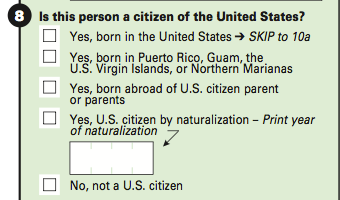
In an article for the Washington Times, Kerry Picket writes that the 2010 census lacks citizenship question. Now, on a certain technical weasel level, she is correct. It is indeed the first decennial United States census (since 1880, but I suppose that's relatively minor compared to her other errors) in which zero citizens will be asked their citizenship status.

However, it is also the first decennial census since 1870 in which zero citizens will be asked their marital status. It is the first since 1960 which will not report poverty status. The first since 1840 which will not report on school attendance. The first since 1930 which will not report on educational attainment (i.e. high school grad, college grad, etc.). The first since 1860 which will ask zero citizens about where their parents and/or ancestors were born. The first since 1840 which will ask zero citizens what they do for a living. The first since 1840 which will not ask if they live on a farm.

Why all these cuts? Because the Census Bureau, pursuant to legislation, replaced the long form of the Census with the American Community Survey (ACS).

From the Census Bureau's Introduction to the ACS

The Census Bureau’s American Community Survey is an ongoing survey that produces important statistics about our nation’s people and housing. It covers the same type of information that had been collected every 10 years from the decennial census long form questionnaire. The American Community Survey eliminated the need for a separate long form in the 2010 Census.
...
With the American Community Survey, it’s no longer necessary to rely on a single snapshot of an area that becomes increasingly dated throughout the decade. Instead, the survey provides a moving picture of community characteristics — a more efficient use of taxpayer dollars.

As it so happens, the most recent American Community Survey form, the 2009 American Community Survey, does, in fact, ask about citizenship.


Now, in 2000, the Census Bureau only asked about citizenship on the long form, which went to 1 out of 6 households. The American Community Survey asks about 3 million housing units these questions each year, so about 30 million housing units over a 10 year span. The United States has about 130 million housing units according to the latest available Census estimates, and 30/130 is greater than 1/6, so a larger percentage of people are being asked about citizenship this decade than last decade by the Census Bureau.

In fact, this is a larger percentage of citizens since they asked about citizenship on the short form in 1950 (the year, and all other years cited, come from a compilation of Census questions by Grace York at the University of Michigan Library). Apparently President Eisenhower was a major fan of illegal immigrants or something and dropped the question.

Of course, that's not fair to President Eisenhower, despite his suspiciously foreign-sounding name, nearly as bad as Obama. After all, the Census Bureau has never asked about the legal status of people. They have asked whether someone was free or a slave, back in the day when slaves were counted as 3/5 of a person, but never about their legal status in the country.

The 2010 Census: Short Forms for Everybody, and Gay Couples Will be Counted

I had not realized this before, but apparently the Census Bureau's long form is no more. The 2000 Census was its' final hurrah.

One of the most significant changes in modern census history will occur in 2010 ― for the first time since 1930, all addresses in the U.S. will receive a census short form.
In recent censuses, most addresses received one of two forms: either the short form, which focused on the population count and demographics; or the long form, which included additional questions on socioeconomic and housing characteristics. Nationwide, about one-in-six addresses in 2000 received the long form. Together, the two parts of the decennial census showed not only the number of people living in America but also the way we live: education, housing, jobs and more. This information will still be part of the decennial census, but it will be collected on a continuing basis as part of the American Community Survey.

The American Community Survey is sent out to some number of households every few months; this allows the government to have a more up-to-date estimate of important demographic/social/economic/etc. issues, as a lot changes in 10 years.

Instead, the head of each household this year must answer only 10 questions, plus an additional 7 questions for each other household member. The form can be viewed here.

The questions include the following:

  1. For the head only Number of residents in the place of residence
  2. For the head only Whether any additional people were staying in the place of residence on April 1, 2010 that were not counted in question 1.
  3. For the head only Ownership status of residence-owned with mortgage; owned and fully paid off; returned; occupied without paying (squatting)
  4. For the head only Telephone Number-so they can contact you if an answer cannot be understood
  5. I wonder how many people will get confused, since these days pretty much every other form these days specifies specific types of phone numbers (cell, work, home)
  6. For everyone Last Name (15 characters; a poor decision on the Census Bureau's part. They really could've minimally redrawn the form to allow for last name to be on its own line and have a limit of as much as 21 characters. However, thankfully, the 15 character limit just fits my own last name), First Name (13 characters, which is also perhaps a poor decision, but perhaps not) and Middle Initial
  7. For everyone EXCEPT for the head of household How this person is related to the head of household; categories include:
    • Husband or wife
    • Biological son or daughter
    • Adopted son or daughter
    • Stepson or stepdaughter
    • Brother or sister
    • Father or mother
    • Grandchild
    • Parent-in-law
    • Son-in-law or daughter-in-law
    • Other Relative I suppose this was in the interest of space as they felt other things would be uncommon enough
    • Roomer or boarder (i.e. someone who pays rent to you)
    • Housemate or roommate (i.e. equal to you)
    • Unmarried partner (for all those Americans living in sin today)
    • Other non-relative I guess a catch-all for those who don't like the other categories
  8. For Everyone What is this person's sex? Male, female only, though I suppose that technically doesn't affect transgendered people since they still answer one or the other
  9. For Everyone Age, as well as month, day and year of birth
  10. For Everyone Hispanic, Latino, Spanish origin; this is still not considered to be a race. The three "popular" subsets of origins are still Mexican/Mexican Am./Chicano, Puerto Rican, and Cuban; all other Hispanic,Latino, Spanish origins must write in their specific origin by hand
  11. For Everyone Race: White, black, American Indian Alaska Native (with tribe as a write-in), a bunch of different Asian country origins, and some other race
  12. For everyone Whether or not they sometimes live or stay somewhere else

There are several interesting things about the Census form.

There is obviously the whole Negro controversy on the Census form; it says "Black, African Am., or Negro"

The interesting thing about the 'related' form is that it does allow the government to track same-sex couples (if the person checking husband or wife or unmarried partner is the same gender as the head of household) in a way that doesn't "offend" conservatives. After all, it would be far more convoluted and nasty to have to design the form in a way that would prevent such information from being collected. It could be done, I suppose, but it would be pretty terribly convoluted and probably mess up Census data.