
Why in the world would you choose to compress using "Compression 98?"
The algorithm, also known as PPMd, was written by Dmitry Shkarin, a guy in Russia. Do they not know that in Soviet Russia, algorithm compress YOU!
But seriously, Winzip is basically the only zip utility that can handle it
And why for that one rdp_2008_06077_tabblock10.zip (and its state-level equivalent, rdp_2008_06_tabblock10.zip);
Took me nearly two hours to get around the limited account privileges on the only
Windows machine I have access to so I could install Winzip and unzip.
Showing posts with label U.S. Census Bureau. Show all posts
Showing posts with label U.S. Census Bureau. Show all posts
Friday, January 29, 2010
Monday, January 11, 2010
Kerry Picket Errs Regarding Citizenship Question in 2010 Census
In an article for the Washington Times, Kerry Picket writes that the 2010 census lacks citizenship question. Now, on a certain technical weasel level, she is correct. It is indeed the first decennial United States census (since 1880, but I suppose that's relatively minor compared to her other errors) in which zero citizens will be asked their citizenship status.
However, it is also the first decennial census since 1870 in which zero citizens will be asked their marital status. It is the first since 1960 which will not report poverty status. The first since 1840 which will not report on school attendance. The first since 1930 which will not report on educational attainment (i.e. high school grad, college grad, etc.). The first since 1860 which will ask zero citizens about where their parents and/or ancestors were born. The first since 1840 which will ask zero citizens what they do for a living. The first since 1840 which will not ask if they live on a farm.
Why all these cuts? Because the Census Bureau, pursuant to legislation, replaced the long form of the Census with the American Community Survey (ACS).
From the Census Bureau's Introduction to the ACS
As it so happens, the most recent American Community Survey form, the 2009 American Community Survey, does, in fact, ask about citizenship.
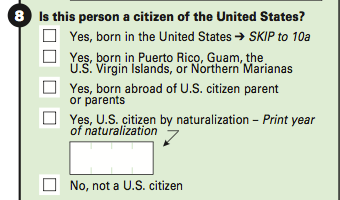
Now, in 2000, the Census Bureau only asked about citizenship on the long form, which went to 1 out of 6 households. The American Community Survey asks about 3 million housing units these questions each year, so about 30 million housing units over a 10 year span. The United States has about 130 million housing units according to the latest available Census estimates, and 30/130 is greater than 1/6, so a larger percentage of people are being asked about citizenship this decade than last decade by the Census Bureau.
In fact, this is a larger percentage of citizens since they asked about citizenship on the short form in 1950 (the year, and all other years cited, come from a compilation of Census questions by Grace York at the University of Michigan Library). Apparently President Eisenhower was a major fan of illegal immigrants or something and dropped the question.
Of course, that's not fair to President Eisenhower, despite his suspiciously foreign-sounding name, nearly as bad as Obama. After all, the Census Bureau has never asked about the legal status of people. They have asked whether someone was free or a slave, back in the day when slaves were counted as 3/5 of a person, but never about their legal status in the country.
However, it is also the first decennial census since 1870 in which zero citizens will be asked their marital status. It is the first since 1960 which will not report poverty status. The first since 1840 which will not report on school attendance. The first since 1930 which will not report on educational attainment (i.e. high school grad, college grad, etc.). The first since 1860 which will ask zero citizens about where their parents and/or ancestors were born. The first since 1840 which will ask zero citizens what they do for a living. The first since 1840 which will not ask if they live on a farm.
Why all these cuts? Because the Census Bureau, pursuant to legislation, replaced the long form of the Census with the American Community Survey (ACS).
From the Census Bureau's Introduction to the ACS
The Census Bureau’s American Community Survey is an ongoing survey that produces important statistics about our nation’s people and housing. It covers the same type of information that had been collected every 10 years from the decennial census long form questionnaire. The American Community Survey eliminated the need for a separate long form in the 2010 Census.
...
With the American Community Survey, it’s no longer necessary to rely on a single snapshot of an area that becomes increasingly dated throughout the decade. Instead, the survey provides a moving picture of community characteristics — a more efficient use of taxpayer dollars.
As it so happens, the most recent American Community Survey form, the 2009 American Community Survey, does, in fact, ask about citizenship.
Now, in 2000, the Census Bureau only asked about citizenship on the long form, which went to 1 out of 6 households. The American Community Survey asks about 3 million housing units these questions each year, so about 30 million housing units over a 10 year span. The United States has about 130 million housing units according to the latest available Census estimates, and 30/130 is greater than 1/6, so a larger percentage of people are being asked about citizenship this decade than last decade by the Census Bureau.
In fact, this is a larger percentage of citizens since they asked about citizenship on the short form in 1950 (the year, and all other years cited, come from a compilation of Census questions by Grace York at the University of Michigan Library). Apparently President Eisenhower was a major fan of illegal immigrants or something and dropped the question.
Of course, that's not fair to President Eisenhower, despite his suspiciously foreign-sounding name, nearly as bad as Obama. After all, the Census Bureau has never asked about the legal status of people. They have asked whether someone was free or a slave, back in the day when slaves were counted as 3/5 of a person, but never about their legal status in the country.


The 2010 Census: Short Forms for Everybody, and Gay Couples Will be Counted
I had not realized this before, but apparently the Census Bureau's long form is no more. The 2000 Census was its' final hurrah.
The American Community Survey is sent out to some number of households every few months; this allows the government to have a more up-to-date estimate of important demographic/social/economic/etc. issues, as a lot changes in 10 years.
Instead, the head of each household this year must answer only 10 questions, plus an additional 7 questions for each other household member. The form can be viewed here.
The questions include the following:
There are several interesting things about the Census form.
There is obviously the whole Negro controversy on the Census form; it says "Black, African Am., or Negro"
The interesting thing about the 'related' form is that it does allow the government to track same-sex couples (if the person checking husband or wife or unmarried partner is the same gender as the head of household) in a way that doesn't "offend" conservatives. After all, it would be far more convoluted and nasty to have to design the form in a way that would prevent such information from being collected. It could be done, I suppose, but it would be pretty terribly convoluted and probably mess up Census data.
One of the most significant changes in modern census history will occur in 2010 ― for the first time since 1930, all addresses in the U.S. will receive a census short form.
In recent censuses, most addresses received one of two forms: either the short form, which focused on the population count and demographics; or the long form, which included additional questions on socioeconomic and housing characteristics. Nationwide, about one-in-six addresses in 2000 received the long form. Together, the two parts of the decennial census showed not only the number of people living in America but also the way we live: education, housing, jobs and more. This information will still be part of the decennial census, but it will be collected on a continuing basis as part of the American Community Survey.
The American Community Survey is sent out to some number of households every few months; this allows the government to have a more up-to-date estimate of important demographic/social/economic/etc. issues, as a lot changes in 10 years.
Instead, the head of each household this year must answer only 10 questions, plus an additional 7 questions for each other household member. The form can be viewed here.
The questions include the following:
- For the head only Number of residents in the place of residence
- For the head only Whether any additional people were staying in the place of residence on April 1, 2010 that were not counted in question 1.
- For the head only Ownership status of residence-owned with mortgage; owned and fully paid off; returned; occupied without paying (squatting)
- For the head only Telephone Number-so they can contact you if an answer cannot be understood I wonder how many people will get confused, since these days pretty much every other form these days specifies specific types of phone numbers (cell, work, home)
- For everyone Last Name (15 characters; a poor decision on the Census Bureau's part. They really could've minimally redrawn the form to allow for last name to be on its own line and have a limit of as much as 21 characters. However, thankfully, the 15 character limit just fits my own last name), First Name (13 characters, which is also perhaps a poor decision, but perhaps not) and Middle Initial
- For everyone EXCEPT for the head of household How this person is related to the head of household; categories include:
- Husband or wife
- Biological son or daughter
- Adopted son or daughter
- Stepson or stepdaughter
- Brother or sister
- Father or mother
- Grandchild
- Parent-in-law
- Son-in-law or daughter-in-law
- Other Relative I suppose this was in the interest of space as they felt other things would be uncommon enough
- Roomer or boarder (i.e. someone who pays rent to you)
- Housemate or roommate (i.e. equal to you)
- Unmarried partner (for all those Americans living in sin today)
- Other non-relative I guess a catch-all for those who don't like the other categories
- For Everyone What is this person's sex? Male, female only, though I suppose that technically doesn't affect transgendered people since they still answer one or the other
- For Everyone Age, as well as month, day and year of birth
- For Everyone Hispanic, Latino, Spanish origin; this is still not considered to be a race. The three "popular" subsets of origins are still Mexican/Mexican Am./Chicano, Puerto Rican, and Cuban; all other Hispanic,Latino, Spanish origins must write in their specific origin by hand
- For Everyone Race: White, black, American Indian Alaska Native (with tribe as a write-in), a bunch of different Asian country origins, and some other race
- For everyone Whether or not they sometimes live or stay somewhere else
There are several interesting things about the Census form.
There is obviously the whole Negro controversy on the Census form; it says "Black, African Am., or Negro"
The interesting thing about the 'related' form is that it does allow the government to track same-sex couples (if the person checking husband or wife or unmarried partner is the same gender as the head of household) in a way that doesn't "offend" conservatives. After all, it would be far more convoluted and nasty to have to design the form in a way that would prevent such information from being collected. It could be done, I suppose, but it would be pretty terribly convoluted and probably mess up Census data.
Monday, September 8, 2008
Are Poor Age Samplings Skewing the Polls?
Now, obviously, things aren't looking as good for Barack Obama as they were a month or so ago. The United States is, in fact, seriously at risk of four more years of decline in economic and political strength, unconstitutional power grabs, and environmental degradation under a McCain/Palin presidency. The polls range from a tie between McCain and Obama to a poll (probably an outlier, but still worrisome) showing McCain ten points out.
However, in looking at the sample used by The Diageo/Hotline poll (the only recent poll to have released data from its sample), I can't help feeling hopeful that the sample is skewed to make McCain look more favorable.
The reason I think this is that their polling sample skews far older than the likely electorate. The U.S. Census Bureau reported the following breakdown of those voting in 2004 by age (See Table 1):
18-29: 16.00%
30-44: 27.33%
45-54: 21.32%
55-64: 16.32%
65+: 19.03%
For the Diageo/Hotline poll, the samples are as follows:
18-29: 6%
30-44: 20%
45-54: 20%
55-64: 22%
65+: 28%
Unknown/Refused: 4%
That's a pretty significant skewing. Their sample has 50% of registered voters (like some other firms, they haven't bothered trying to construct a likely voter sample; USA Today/Gallup did, and they had a 6 point gap between their results registered voters (McCain +4) and likely voters (McCain +10)); I have not been able to locate crosstabs) over the age of 55, though this age group made up only 35% of those voting in 2004, and has voters under 45 making up only 26% of voters, though they made up 43% of those voting in 2004.
While the electorate has continued to age, given the massive registration drives by the Obama campaign and the significant enthusiasm among younger voters this election, it's highly, highly unlikely that those over 55 will increase their share of the electorate by even more than 5 points. More than 10 points is pretty much out of the question, much less 15. It's far likelier that their share will remain constant or even stagnate than increase by more than 5 points.
For instance, between the 2000 and 2004 elections:
The percentage of citizens over 18 who were over 55 grew from 29.27% to 31.40% due nearly entirely to the oldest baby boomers (defined here as those born between 1946 and 1964) starting to reach old agehood during that time period; those between 55 and 64 went from 12.2% to 14.3% of those over 18, while citizens over 65 just barely increased from 17.07% to 17.1% (well within the margin of error, though a small increase is likely).
Meanwhile, the percentage of citizens over 18 who were under the age of 45 shrunk from 51.83% to 48.80%, largely due to all but the very youngest boomers having left the 30-44 age group (down from 30.72% to 27.94%); the share of 18-29 year olds remained fairly constant to within the MOE, 21.1%-20.86% as more Generation Yers reached voting age;
Given that even more baby boomers will have moved into this category by November 2008 (including my parents), I'd expect another spike, placing voting-age citizens over 55 at between 32% and 35% of the population, and a decrease in voting-age citizens under 45, placing those citizens at between 45 and 48% of the population.
However, that will likely be lessened by voting trends. For instance, the percentage of those casting ballots who were under 45 decreased only a little, from 44.55% to 43.33%, due to a major increase in registration (and turnout) among those under 30; from 54.87% of citiens in 2000 to 60.03% of citizens in 2004, and a smaller increase (but still larger than for those 45 and over) among those between 30-44.
Similarly, those voting increased from only 55.45% to 56.67%.
Given registration trends in those few states with numbers by age and enthusiasm factors, I expect the percentages of those voting in these age groups to change by less than 1%.
I'm not sure whether polling firms had similarly poor sampling in 2004. However, if it had shown up, it wouldn't have made that much of a difference. Looking at CNN's 2004 Exit Poll (which, while not without its own problems, is far, far more likely to have its margin at within < 5 points of the actual numbers than a telephone opinion poll)
While Kerry did do significantly (15 points) better among those under 30 (won 54-45) than he did among those 30 and up (lost 47-53), among those over 30, there was very little if any differences based on age, where every group listed (30-44, 45-59, 60+, and 65+) was between 51-48 and 54-46, a 5 point margin difference.
This is not going to be the case. Barack Obama has excited the youth of this country, who are more progressive (in particular on social and environmental issues [which we have to live with longer] as well as foreign policy) than older Americans; Obama is expected to do particularly well among those under 30, who came of political age during the era of disgustingly hyper-partisanship in either the good years of Bill Clinton or the awful, awful years of George W. Bush, tired of the way things are in DC but wanting to change them.
On the flip side, several factors are combining to hurt Senator Obama among those over 65. First of all, his being African-American. Those whites who were 65 or older formed their political views either during the civil rights era [those who will be 65 by this November were old enough to vote for Lyndon Johnson in 1964 unless they were born a day or so too late in November] or before, may well have participated in white flight, and for various reasons are more likely to have negative view of African-Americans.
Second of all, older people tend to want "experience," at least aside from the ones who remember and resented the same charge being thrown at JFK (though he and Nixon actually both had 14 years in federal office [though Nixon moved up to the Senate 2 years earlier and then spent 8 years as VP]); at any rate, those generally considered to be our 3 greatest presidents didn't have all that much government experience.
I guess in these scenarios, here's who each person would be.
1860:
McCain = Stephen Douglas ("little", long-time Senator, faux maverick who caused somewhat of a breakaway [with Ron Paul/Bob Barr = combination of Breckinridge and Bell; though with less support], died soon after the 1860-election)
1932:
George Bush and John McCain combine as Herbert Hoover.
Back to older people and Senator Obama. The third problem is that they're less used to having to be skeptical of the media, because for most of their life, it functioned very well and only recently descended into its current form. Moreover, they are more likely to believe (and be scared by) the "He's an anti-patriotic Muslim" e-mail due to this trust in media and general less understanding of technology.
The point of this long piece being that poor age sampling may be overestimating John McCain's percentage of the vote.
However, in looking at the sample used by The Diageo/Hotline poll (the only recent poll to have released data from its sample), I can't help feeling hopeful that the sample is skewed to make McCain look more favorable.
The reason I think this is that their polling sample skews far older than the likely electorate. The U.S. Census Bureau reported the following breakdown of those voting in 2004 by age (See Table 1):
18-29: 16.00%
30-44: 27.33%
45-54: 21.32%
55-64: 16.32%
65+: 19.03%
For the Diageo/Hotline poll, the samples are as follows:
18-29: 6%
30-44: 20%
45-54: 20%
55-64: 22%
65+: 28%
Unknown/Refused: 4%
That's a pretty significant skewing. Their sample has 50% of registered voters (like some other firms, they haven't bothered trying to construct a likely voter sample; USA Today/Gallup did, and they had a 6 point gap between their results registered voters (McCain +4) and likely voters (McCain +10)); I have not been able to locate crosstabs) over the age of 55, though this age group made up only 35% of those voting in 2004, and has voters under 45 making up only 26% of voters, though they made up 43% of those voting in 2004.
While the electorate has continued to age, given the massive registration drives by the Obama campaign and the significant enthusiasm among younger voters this election, it's highly, highly unlikely that those over 55 will increase their share of the electorate by even more than 5 points. More than 10 points is pretty much out of the question, much less 15. It's far likelier that their share will remain constant or even stagnate than increase by more than 5 points.
For instance, between the 2000 and 2004 elections:
The percentage of citizens over 18 who were over 55 grew from 29.27% to 31.40% due nearly entirely to the oldest baby boomers (defined here as those born between 1946 and 1964) starting to reach old agehood during that time period; those between 55 and 64 went from 12.2% to 14.3% of those over 18, while citizens over 65 just barely increased from 17.07% to 17.1% (well within the margin of error, though a small increase is likely).
Meanwhile, the percentage of citizens over 18 who were under the age of 45 shrunk from 51.83% to 48.80%, largely due to all but the very youngest boomers having left the 30-44 age group (down from 30.72% to 27.94%); the share of 18-29 year olds remained fairly constant to within the MOE, 21.1%-20.86% as more Generation Yers reached voting age;
Given that even more baby boomers will have moved into this category by November 2008 (including my parents), I'd expect another spike, placing voting-age citizens over 55 at between 32% and 35% of the population, and a decrease in voting-age citizens under 45, placing those citizens at between 45 and 48% of the population.
However, that will likely be lessened by voting trends. For instance, the percentage of those casting ballots who were under 45 decreased only a little, from 44.55% to 43.33%, due to a major increase in registration (and turnout) among those under 30; from 54.87% of citiens in 2000 to 60.03% of citizens in 2004, and a smaller increase (but still larger than for those 45 and over) among those between 30-44.
Similarly, those voting increased from only 55.45% to 56.67%.
Given registration trends in those few states with numbers by age and enthusiasm factors, I expect the percentages of those voting in these age groups to change by less than 1%.
I'm not sure whether polling firms had similarly poor sampling in 2004. However, if it had shown up, it wouldn't have made that much of a difference. Looking at CNN's 2004 Exit Poll (which, while not without its own problems, is far, far more likely to have its margin at within < 5 points of the actual numbers than a telephone opinion poll)
While Kerry did do significantly (15 points) better among those under 30 (won 54-45) than he did among those 30 and up (lost 47-53), among those over 30, there was very little if any differences based on age, where every group listed (30-44, 45-59, 60+, and 65+) was between 51-48 and 54-46, a 5 point margin difference.
This is not going to be the case. Barack Obama has excited the youth of this country, who are more progressive (in particular on social and environmental issues [which we have to live with longer] as well as foreign policy) than older Americans; Obama is expected to do particularly well among those under 30, who came of political age during the era of disgustingly hyper-partisanship in either the good years of Bill Clinton or the awful, awful years of George W. Bush, tired of the way things are in DC but wanting to change them.
On the flip side, several factors are combining to hurt Senator Obama among those over 65. First of all, his being African-American. Those whites who were 65 or older formed their political views either during the civil rights era [those who will be 65 by this November were old enough to vote for Lyndon Johnson in 1964 unless they were born a day or so too late in November] or before, may well have participated in white flight, and for various reasons are more likely to have negative view of African-Americans.
Second of all, older people tend to want "experience," at least aside from the ones who remember and resented the same charge being thrown at JFK (though he and Nixon actually both had 14 years in federal office [though Nixon moved up to the Senate 2 years earlier and then spent 8 years as VP]); at any rate, those generally considered to be our 3 greatest presidents didn't have all that much government experience.
- George Washington had been appointed a surveyor at one point; other than that, he'd just been a soldier (albeit reaching the office of General).
- Abraham Lincoln had a grand total of 2 years in office, in the House of Representatives over 10 years before running.
- FDR had 2 years as Governor of New York before beginning his run for the presidency (he'd also been Assistant Secretary of the Navy for 8 years and a state Senator for 2).
I guess in these scenarios, here's who each person would be.
1860:
McCain = Stephen Douglas ("little", long-time Senator, faux maverick who caused somewhat of a breakaway [with Ron Paul/Bob Barr = combination of Breckinridge and Bell; though with less support], died soon after the 1860-election)
1932:
George Bush and John McCain combine as Herbert Hoover.
Back to older people and Senator Obama. The third problem is that they're less used to having to be skeptical of the media, because for most of their life, it functioned very well and only recently descended into its current form. Moreover, they are more likely to believe (and be scared by) the "He's an anti-patriotic Muslim" e-mail due to this trust in media and general less understanding of technology.
The point of this long piece being that poor age sampling may be overestimating John McCain's percentage of the vote.
Subscribe to:
Posts (Atom)
